The quick answer: Shockwave therapy is a noninvasive treatment that delivers controlled acoustic waves to an injured area. It may reduce pain and support healing in certain persistent tendon, fascia, and soft-tissue conditions, including plantar fasciitis, Achilles tendinopathy, and tennis elbow. Results vary, so an examination is necessary before treatment.
Have you been stretching, resting, icing, and waiting for an injury to improve—only to feel the same pain every time you get out of bed, pick up a coffee mug, or try to exercise?
You are not alone.
At Forward Spine Center, we regularly meet people who are not dealing with a brand-new injury. They are dealing with something that has been hanging around for weeks or months and does not seem interested in leaving.
That is where shockwave therapy may be worth discussing.
Shockwave therapy is available at our Golden Valley chiropractic clinic for people experiencing certain persistent tendon, fascia, and musculoskeletal problems. It is noninvasive, does not involve medication or injections, and usually allows patients to return to their normal day immediately after treatment.
Let’s explain what it is, what the evidence says, what it may help, and what you should expect before scheduling an appointment.
What is shockwave therapy?
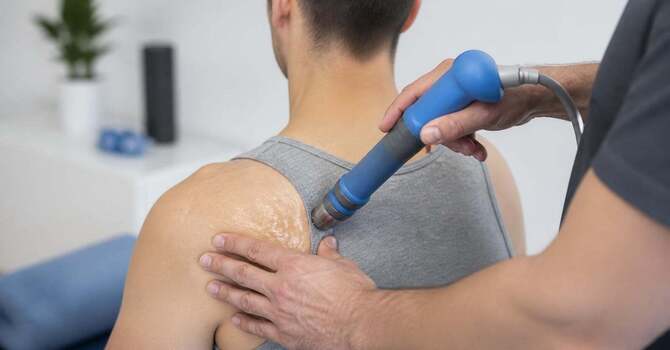
Shockwave therapy uses targeted acoustic waves to create a mechanical stimulus inside injured or irritated tissue.
Despite the name, there is no electrical shock involved.
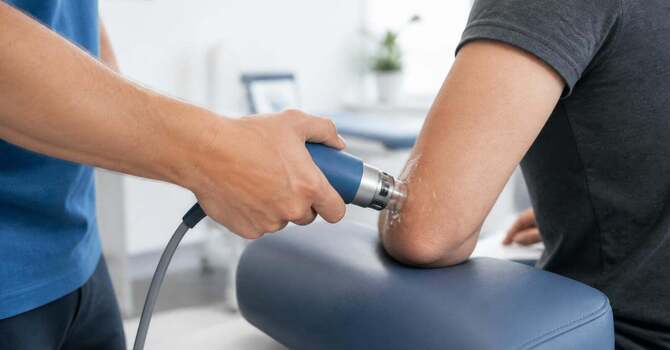
A handheld applicator delivers controlled pulses through the skin and into the treatment area. These acoustic waves create mechanical stimulation within the tissue, a process commonly called mechanotransduction. Mayo Clinic describes focused shockwave and radial pressure-wave therapy as transcutaneous acoustic-wave treatments that can influence cellular activity, pain pathways, and new blood-vessel formation.
In simple terms, the treatment gives an area that has struggled to heal a new physical stimulus. Researchers are still studying the exact mechanisms and ideal treatment protocols, so shockwave therapy should not be presented as a guaranteed tissue-repair shortcut.
Shockwave technology was first used medically to break apart kidney stones. Different forms of the technology were later developed for orthopedic and musculoskeletal care.
How does shockwave therapy work?
When you experience an acute injury, your body normally initiates a healing response. Blood flow increases, repair cells move into the area, and damaged tissue gradually remodels.
Sometimes that process slows down.
This can happen with chronic tendon problems, repetitive strain injuries, and areas that continue to be irritated by movement, work, or exercise. You may feel well enough to remain active, but the tissue never seems to make it through the full recovery process.
Shockwave therapy applies acoustic energy to the problem area. Depending on the device and the condition being treated, these waves may:
- Stimulate local circulation and cellular activity.
- Influence how pain signals are processed.
- Encourage tissue remodeling.
- Help address persistent tendon or fascia problems.
The leading explanation involves mechanotransduction: cells convert a mechanical stimulus into biological activity. Published reviews describe possible effects involving tissue regeneration, angiogenesis, bone remodeling, and pain modulation, while also noting that the mechanisms are not fully settled.
It is not magic, and it does not instantly rebuild damaged tissue.
We use shockwave therapy as part of a larger plan that may include activity changes, mobility work, strengthening, chiropractic care, acupuncture, or rehabilitation. Feeling less pain is helpful. Improving the reason the area became overloaded is often what helps you stay active.
Does shockwave therapy work for chronic pain?
Shockwave therapy can help some chronic musculoskeletal conditions, especially persistent tendon and fascia problems, but it does not treat every cause of chronic pain.
The evidence is strongest for certain localized conditions rather than for chronic pain as one broad category. Diagnosis matters. Treatment settings matter. The rehabilitation plan matters. Your health history and activity demands matter too.
That is why we do not begin with the machine.
We begin with an evaluation.
Pain in your heel, elbow, or shoulder can have several possible causes. Shockwave therapy may fit one cause and be completely inappropriate for another. If your symptoms suggest a fracture, infection, nerve problem, systemic condition, or another diagnosis, further evaluation, imaging, or referral may be the right next step.
What conditions can shockwave therapy help?
Shockwave therapy is most commonly considered for chronic musculoskeletal conditions, particularly problems involving tendons and the areas where tendons attach to bone. Cleveland Clinic lists plantar fasciitis, tennis elbow, golfer’s elbow, and other soft-tissue problems among its musculoskeletal uses.
At Forward Spine Center, we may evaluate shockwave therapy for conditions such as:
- Plantar fasciitis and chronic heel pain.
- Achilles tendinopathy.
- Tennis elbow.
- Golfer’s elbow.
- Rotator cuff or shoulder tendon pain.
- Patellar tendon pain.
- Shin splints.
- Other stubborn tendon and soft-tissue injuries.
The quality of evidence and expected results are not identical for every condition. A list of possible uses is not the same as a diagnosis or a promise that treatment will work.
Does shockwave therapy work for plantar fasciitis?
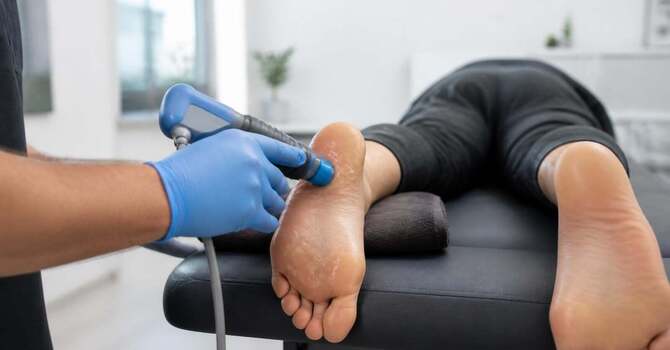
Shockwave therapy may reduce pain in some people with persistent plantar fasciitis, particularly when basic conservative care has not been enough.
Plantar fasciitis commonly causes pain near the bottom of the heel, especially during the first few steps in the morning or after sitting for an extended period. The discomfort may loosen as you move around, only to return later in the day.
A 2025 systematic review and meta-analysis evaluated 15 studies involving 1,123 patients. The researchers found that extracorporeal shockwave therapy performed better than placebo for plantar fasciitis pain, although platelet-rich plasma and custom orthotics produced stronger results on certain measures.
That last part matters.
Shockwave therapy is an option, not the only option. The right plan may also involve:
- Footwear changes or orthotics.
- Calf and ankle mobility work.
- Plantar fascia exercises.
- Load management.
- Progressive strengthening.
For someone whose heel pain has not improved with basic conservative care, shockwave therapy may provide another noninvasive treatment route before considering more involved procedures.
Does shockwave therapy work for tennis elbow?
Shockwave therapy may help some people with persistent tennis elbow, but current evidence does not show that one shockwave type is consistently best for pain and function.
Tennis elbow is not limited to tennis players.
It can affect mechanics, construction workers, hairstylists, healthcare workers, golfers, weightlifters, office workers, and anyone repeatedly gripping, lifting, or extending the wrist.
Patients often feel pain along the outside of the elbow when they:
- Grip an object.
- Shake someone’s hand.
- Lift a bag or coffee cup.
- Use a screwdriver or tool.
- Perform curls or pulling exercises.
A 2026 systematic review and meta-analysis found that radial and focused shockwave treatments both reduced pain in tennis elbow. The authors could not establish one consistently superior approach for pain and function because the certainty of the available evidence was limited.
The practical takeaway is simple: the provider’s assessment, the diagnosis, and the overall rehabilitation plan matter more than choosing treatment based only on a device name.
What does shockwave therapy feel like?
Most people describe the treatment as a rapid tapping, flicking, or pulsing sensation. Cleveland Clinic notes that the intensity can be reduced if the treatment becomes uncomfortable.
We apply the handheld device directly over the targeted area and adjust the treatment based on the tissue, location, and your comfort. The shockwave portion of an appointment at Forward Spine Center generally takes approximately five to 10 minutes.
Some areas are more sensitive than others, especially when we pass over the exact location that has been bothering you. Treatment should remain tolerable, and the intensity can be adjusted.
Afterward, you may experience temporary:
- Soreness or tenderness.
- Redness or skin irritation.
- Mild bruising.
- Temporary numbness.
- A sensation similar to what you might feel after exercise.
Serious complications are uncommon when the treatment is used appropriately. Reported side effects can include mild discomfort, skin irritation or discoloration, bruising, numbness, nausea, or headache.
Is there downtime after shockwave therapy?
Most patients can return to work and ordinary daily activity after shockwave therapy, but strenuous use of the treated area may need to be modified.
You do not need an incision, anesthesia, or a lengthy surgical recovery period. Cleveland Clinic describes acoustic-wave therapy as noninvasive and associated with a quick recovery time.
Being able to return to your day does not always mean you should immediately perform a maximum-effort workout involving the treated area.
We may recommend temporarily modifying an activity depending on:
- The condition being treated.
- How irritated the tissue is.
- Your current training or work demands.
- How the area responds after treatment.
- Whether shockwave therapy is being combined with rehabilitation.
Our goal is not merely to help you feel better for an afternoon. It is to help the area tolerate the demands you regularly place on it.
How many shockwave treatments will I need?
There is no single treatment schedule that fits every patient.
The appropriate number of visits depends on your diagnosis, how long the problem has been present, the severity of the tissue irritation, the treatment protocol, and how you respond during the first few sessions.
Some people notice an early change in pain or mobility. Others improve more gradually as the tissue responds over the following weeks. A meaningful treatment plan should include progress checks rather than automatic continuation without measurable improvement.
We will discuss the recommended plan after examining you.
Who is a good candidate for shockwave therapy?
You may be a potential candidate when:
- Your pain has persisted despite rest or basic home care.
- The problem involves a tendon, fascia, or localized soft-tissue structure.
- You want to explore a noninvasive treatment.
- Your symptoms interfere with walking, working, exercising, or sleeping.
- An examination confirms that shockwave therapy is appropriate for the condition.
Shockwave therapy is not automatically the right choice for every painful area. Before treatment, your provider should review your medical history and examine the affected region. Imaging or referral may also be appropriate when the diagnosis is uncertain.
Who should not have shockwave therapy?
Shockwave therapy may be inappropriate in certain situations, so a medical-history review is necessary before treatment.
Be prepared to discuss pregnancy, bleeding or clotting concerns, medications, implanted medical devices, recent injections, infections, fractures, cancer in the treatment area, and other significant health conditions.
Mayo Clinic identifies pregnancy, local tumor or infection, treatment over air-filled tissue, and treatment within six weeks of a local corticosteroid injection among situations in which extracorporeal shockwave therapy may be inappropriate. A clinical best-practices review also recommends caution with anticoagulation or clotting disorders and notes special considerations for pacemakers or implanted cardiac devices.
This list is not exhaustive. The decision should be based on your history, examination, treatment area, device, and clinical circumstances.
Is shockwave therapy the same as therapeutic ultrasound?
No.
Both treatments use forms of sound energy, but they are not interchangeable.
Therapeutic ultrasound generally delivers continuous or pulsed sound waves intended to produce thermal or mechanical effects in tissue. Shockwave and radial pressure-wave devices produce distinct acoustic pulses designed to create a stronger mechanical stimulus.
Even within the shockwave category, there are differences:
- Focused shockwave therapy directs energy toward a selected depth.
- Radial pressure-wave therapy has its highest pressure near the applicator and spreads outward through the tissue.
The terminology can become confusing quickly. What matters most is whether the provider understands the condition being treated, uses the technology appropriately, and combines it with a sensible recovery plan.
Why choose Forward Spine Center for shockwave therapy?
Forward Spine Center is a husband-and-wife-owned clinic led by Dr. Timothy Klesk and Dr. Madeline Klesk. Our clinic provides evidence-informed chiropractic care, acupuncture, and rehabilitation for individuals and families in Golden Valley and the surrounding west-metro area.
Both doctors have completed specific training in shockwave therapy and integrate it with the clinic’s other conservative treatment options.
That means we are not looking at your heel, elbow, or shoulder as an isolated sore spot.
We want to understand:
- Why the problem developed.
- Which movements make it worse.
- What you have already tried.
- What activities you want to return to.
- What treatment combination makes sense for you.
Dr. Timothy Klesk completed the Primary Spine Practitioner program through the University of Pittsburgh and focuses on science-driven, conservative care. Dr. Madeline Klesk has additional training in sports-related injuries, acupuncture, women’s health, pregnancy, and pediatric care.
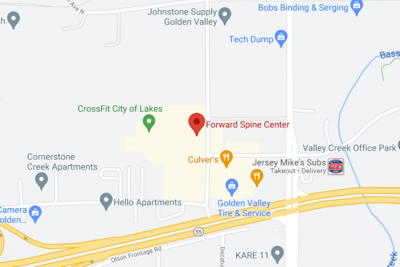
We serve patients from Golden Valley, Plymouth, St. Louis Park, Minneapolis, and neighboring Twin Cities communities. Our Golden Valley clinic is located at 701 Decatur Avenue North, Suite 102, and the clinic phone number is 763-332-2680.
Ready to find out whether shockwave therapy is right for you?
Persistent pain has a way of quietly shrinking your routine.
You stop taking the longer walk. You avoid the stairs. You change how you lift. You skip the workout. Eventually, you may forget how much the problem has changed your day.
You do not have to assume that living around it is your only option.
Schedule an evaluation at Forward Spine Center to determine what is causing your pain and whether shockwave therapy belongs in your treatment plan.
Forward Spine Center
701 Decatur Avenue North, Suite 102
Golden Valley, MN 55427
Call: 763-332-2680
Frequently Asked Questions About Shockwave Therapy
Does shockwave therapy hurt?
Most patients feel tapping, pulsing, or temporary tenderness rather than severe pain. Some treatment areas are more sensitive than others. Your provider can adjust the intensity based on your comfort, and you should communicate if the sensation becomes difficult to tolerate.
How long does a shockwave therapy appointment take?
The shockwave portion of an appointment at Forward Spine Center generally takes approximately five to 10 minutes. An initial visit may take longer because we first need to review your history, examine the painful area, and determine whether shockwave therapy is appropriate.
Can I return to work after shockwave therapy?
Most patients can return to work and ordinary daily activity immediately. Your provider may recommend temporarily modifying strenuous exercise, heavy lifting, or repetitive activity involving the treated area. The advice depends on your diagnosis, work demands, and response to treatment.
How quickly will I notice results?
Some patients notice a change early, while others improve gradually over several treatments and the weeks following care. Results depend on the diagnosis, severity, general health, activity demands, and rehabilitation plan. Shockwave therapy does not produce the same timeline for every patient.
Is shockwave therapy surgery?
No. Shockwave therapy is a noninvasive treatment delivered through the skin with a handheld applicator. There are no incisions, stitches, or surgical recovery period. Temporary soreness, redness, bruising, or numbness can still occur after treatment.
Can shockwave therapy help plantar fasciitis?
Shockwave therapy may help certain patients with persistent plantar fasciitis or plantar heel pain. A 2025 meta-analysis found better pain outcomes than placebo, although other conservative treatments also performed well on some measures. An examination helps determine the most appropriate plan.
Does shockwave therapy permanently eliminate pain?
No treatment can honestly guarantee permanent pain relief. Long-term results depend on the diagnosis, severity, rehabilitation, activity demands, and whether contributing factors are addressed. Additional care may sometimes be needed, and a lack of measurable progress should prompt reassessment rather than automatic continuation.
How do I know whether I am a candidate?
The best way to know is to schedule an evaluation. We will review your health history, examine the painful area, discuss what you have tried, and determine whether shockwave therapy—or another form of conservative care—is the more appropriate option.
Who should avoid shockwave therapy?
Shockwave therapy may be inappropriate during pregnancy or over a local tumor, infection, or air-filled tissue. Recent corticosteroid injections, clotting concerns, anticoagulants, and implanted medical devices also require careful review. Your provider should screen your history before treatment.
Is shockwave therapy the same as ultrasound?
No. Therapeutic ultrasound and shockwave therapy both involve sound energy, but they use different wave characteristics and treatment methods. Focused shockwave and radial pressure-wave devices also differ from each other, so the diagnosis and treatment plan matter more than the device label alone.
More shockwave guides